
TravelGuide
Chengdu & Chongqing Travel Gateway | Pandas, Hot Pot & Beyond
Chengdu & Chongqing Travel Gateway | Pandas, Hot Pot & Beyond
In the splendid artistic treasure trove of Sichuan opera, face-changing and fire-spitting are undoubtedly the most visually striking and mysterious stunts. The former astonishes the audience with its "instantly changing" facial masks, while the latter ignites the venue with the shocking scene of "leaping flames". Between stillness and movement, concealment and revelation, they fully embody the essence of Sichuan opera's roles—Sheng (male lead), Dan (female lead), Jing (painted face), Mo (secondary male), Chou (clown)—as well as the boldness and agility of Bashu culture. These two century-old performing arts are not only iconic symbols of Sichuan opera but also precious gems of traditional Chinese culture with great creativity and expressiveness, carrying the craftsmanship inheritance and cultural perseverance of generations of artists.
The origins of Sichuan opera face-changing and fire-spitting are deeply rooted in the folk culture and opera soil of the Bashu region. As one of China's five major opera genres (Note: The original text incorrectly stated "four major opera genres"; this has been revised), Sichuan opera integrates five major tunes—Kunqiang, Gaoqiang, Huqin, Tanxi, and Dengxi. After hundreds of years of evolution, it has formed an artistic style that combines lyricism and narration, gentleness and boldness. Face-changing and fire-spitting were not inherent; instead, they were gradually innovated and developed by artists in long-term performance practices to more vividly show the inner world of characters and enhance stage appeal.
The origin of face-changing can be traced back to the mid-Qing Dynasty, initially derived from the facial makeup art of Jing roles in Sichuan opera. Early artists resorted to facial makeup to quickly switch character identities and express drastic fluctuations in characters' emotions. Initially, it was simple facial smearing and pasting, which later developed into complex mask-changing techniques. According to legend, the earliest face-changing involved artists painting masks of different colors on thin silk, pasting them on their faces, and quickly tearing them off with specific hand movements during performances to achieve instant mask changes. With the maturity of the art, face-changing techniques continued to enrich, and props became more sophisticated. It gradually developed from the single "tearing face" into various forms such as "smearing face", "blowing face", and "qi-controlled face-changing", becoming one of the most representative stunts in Sichuan opera performances.
The origin of fire-spitting performances is closely related to the folk beliefs of the Bashu region and the needs of opera plots. In traditional Sichuan opera repertoires such as "Legend of the White Snake" and "Biography of Mulian", there are often roles of ghosts, gods, immortals, and chivalrous men. To show the mysterious power or ferocious appearance of these roles, artists created fire-spitting techniques. Early fire-spitting performances were mainly to create a terrifying and fantasy stage atmosphere, and later gradually integrated more artistic elements, becoming a performing stunt with both ornamental and technical qualities. The inheritance of fire-spitting is extremely strict. Artists need to go through long-term breath training and safety drills to present the shocking effect of leaping flames on stage. A slight mistake may endanger their own safety, so this technique is also known as "art on the tip of a knife".
After hundreds of years of inheritance, face-changing and fire-spitting techniques have been continuously improved, becoming "living fossils" of Sichuan opera art. In 2006, Sichuan opera was included in the first batch of National Intangible Cultural Heritage List. As core stunts of Sichuan opera, face-changing and fire-spitting have thus received wider attention and protection, becoming an important window to show the charm of Chinese opera culture to the world.
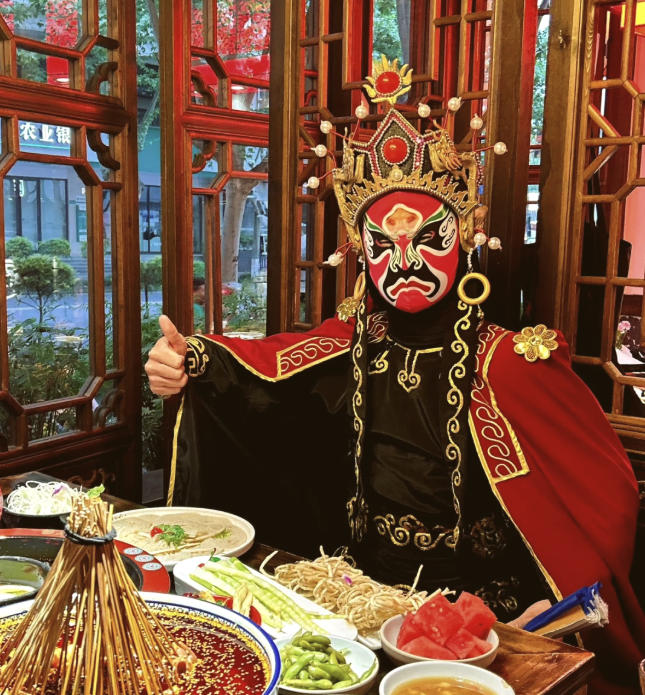
The core charm of Sichuan opera face-changing lies in "change"—in the blink of an eye, one mask fades quietly, and another appears abruptly. Cooperating with the characters' movements, singing, and eyes, it fully shows the joys, sorrows, anger, kindness, evil, beauty, and ugliness in the characters' hearts. The essence of face-changing is not only "speed" but also "accuracy" and "spirit". Every mask change must be accurately aligned with the plot development and character emotions, achieving "changing the face is changing the heart".
In terms of technical classification, Sichuan opera face-changing mainly includes four core techniques, each with its own characteristics and varying degrees of difficulty. The first is "tearing face", which is the most common and ornamental face-changing technique. Artists fix pre-painted masks (usually 10-20 pieces) on their faces with silk threads, with the masks connected to each other. During performances, through flexible finger operations, combined with head turns and body coverings, they quickly tear the masks off their faces to achieve instant changes. The key to "tearing face" lies in the proficiency and concealment of hand movements. Artists' fingers need long-term training to complete mask changes without the audience noticing. At the fastest, they can complete two mask changes in one second, dazzling the audience.
The second is "smearing face", a relatively simple technique. Artists apply pigments of different colors (usually water-soluble pigments) on specific parts of their faces. During performances, they quickly smear and wipe with their palms to change facial colors, thereby realizing changes in emotions and roles. "Smearing face" does not require complex props and mainly relies on artists' hand skills and control of pigments. It is often used to show sudden changes in characters' emotions, such as the transition from calm to anger, or from kindness to evil, which is concise and full of tension.
The third is "blowing face", an extremely interesting technique. Artists hide small boxes containing colored powders (such as gold powder, silver powder, red powder, etc.) in their palms or props. During performances, they blow the powder onto their faces with deep breaths, making their faces instantly dyed the corresponding color. The difficulty of "blowing face" lies in breath control. Artists need to accurately control the intensity and direction of their breath, not only to make the powder evenly adhere to their faces but also not to affect their vision and performance. It is often used to show scenes such as characters' mysterious transformation or immortals descending to earth.
The fourth is "qi-controlled face-changing", the most difficult and mysterious face-changing technique. Without the help of any props or pigments, artists can only make subtle changes in facial colors by adjusting their internal qi and controlling the contraction and relaxation of facial muscles—from ruddy to pale, and from pale to livid—to show the characters' extreme excitement or pain. This technique has extremely high requirements for artists' physical fitness and qi control ability. It takes decades of practice to master, and now few artists can use it proficiently.
In addition to the exquisite techniques, the colors of face-changing masks also contain profound cultural connotations. The colors of Sichuan opera face-changing masks follow fixed meanings: red represents loyalty, courage, and integrity, such as Guan Yu; black represents integrity, fearlessness, and boldness, such as Zhang Fei; white represents treachery and cunning, such as Cao Cao; blue represents unruliness and bravery in battle, such as Dou Erdun; yellow represents resourcefulness, courage, and irritability, such as Dian Wei; green represents bandit heroes and ferocity, such as Cheng Yaojin. Through the switching of masks of different colors, artists can let the audience quickly understand the characters' identities and personalities without too many lines and movements. This is the artistic charm of face-changing.
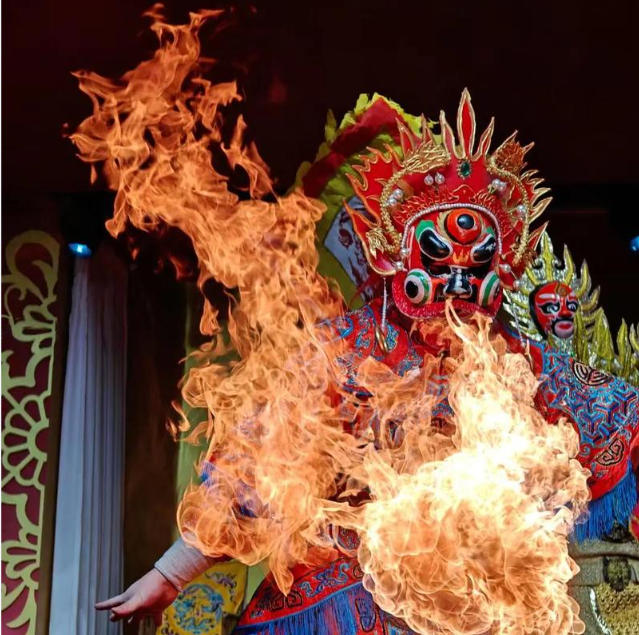
If face-changing is the refinement of "movement hidden in stillness", then fire-spitting is the shock of "power displayed in movement". On the Sichuan opera stage, when an artist opens his mouth and spits out roaring flames, the firelight reddens the entire stage. Cooperating with passionate music and exaggerated movements, it always triggers bursts of exclamation from the audience, pushing the stage atmosphere to a climax. Fire-spitting performances are not only a visual stunt but also a comprehensive embodiment of artists' courage, skills, and experience.
The core of fire-spitting performances lies in the perfect combination of "qi" and "fire". Its principle seems simple, but it actually contains strict technical specifications. Before the performance, the artist will hold a special "fire oil" (usually a mixture of kerosene and diesel, which is highly safe and burns slowly) in his mouth. The amount of oil must be strictly controlled—too much is easy to cause danger, and too little cannot form an obvious flame effect. During the performance, the artist adjusts his breath with deep breathing, then sprays the fire oil in his mouth, and ignites the pre-prepared ignition material (usually a cotton ball or paper twist hidden in his hand) at the same time. When the fire oil contacts the flame, it will form roaring flames gushing out of the mouth, creating an extremely shocking scene.
The difficulty of fire-spitting performances is mainly reflected in three aspects: first, breath control. Artists need to accurately control the intensity and speed of exhalation, not only to spray the fire oil evenly to form continuous flames but also to prevent the fire oil from flowing back into the mouth to avoid burning the oral cavity; second, safety protection. During the performance, the artist's face and oral cavity need to take protective measures, and the position and burning time of the ignition material must also be strictly controlled to prevent the flame from burning themselves or igniting stage props; third, artistic integration. Fire-spitting performances cannot exist in isolation. They need to be perfectly integrated with plot development, character movements, and music rhythm to achieve the best stage effect. For example, in "Legend of the White Snake", the fire-spitting performance when Fahai casts spells, combined with ferocious expressions and exaggerated movements, fully shows Fahai's dignity and coldness; in "Biography of Mulian", fire-spitting is used to show the terrifying scene of hell, enhancing the appeal of the plot.
The inheritance of fire-spitting techniques is extremely strict. When a master accepts apprentices, he not only looks at talent but also values the apprentice's patience, courage, and sense of responsibility. After entering the school, the apprentice first learns breath control, exercises the stability and intensity of breathing through basic training such as blowing candles and paper strips; then learns the preparation of fire oil and safety protection knowledge, understanding the burning effect and potential safety hazards of different fire oil ratios; finally, under the guidance of the master, conducts practical drills, starting with a small amount of fire oil and short-distance fire-spitting, and gradually mastering high-difficulty fire-spitting skills. The entire training process is long and arduous. Usually, it takes 3-5 years for an apprentice to perform independently on stage. Some high-difficulty fire-spitting moves even take decades of practice to reach perfection.
Today, with the continuous development of stage technology, fire-spitting performances have also integrated more modern elements, such as lighting and smoke effects, making the presentation of flames more gorgeous and colorful. However, artists have always adhered to the core of traditional techniques and maintained the original flavor of fire-spitting performances, allowing this ancient stunt to still glow with unique charm in the new era.
Face-changing and fire-spitting performances are not only stunts of Sichuan opera art but also important components of traditional Chinese culture, carrying artists' perseverance of craftsmanship and cultural confidence. In the past, the inheritance of these two techniques was mostly "oral teaching and heart-to-heart transmission". Masters secretly passed on the techniques to apprentices and never easily passed them on to outsiders, so many exquisite techniques were at risk of being lost. With the development of the times, more and more artists have realized the importance of inheritance, began to break traditional constraints, took the initiative to accept apprentices and teach, and systematically and standardizedly passed on face-changing and fire-spitting techniques.
While inheriting, artists are also constantly innovating to adapt face-changing and fire-spitting performances to the aesthetic needs of audiences in the new era. For example, in face-changing performances, artists integrate modern dance and magic elements, making mask changes more smooth and natural, and stage performance more full of tension; in fire-spitting performances, through the cooperation of lighting and smoke, they create more shocking visual effects such as "flying fire dragons" and "flames surrounding the body". At the same time, many artists have gone abroad to hold Sichuan opera performances overseas, showing face-changing and fire-spitting techniques to audiences around the world, allowing more people to understand the charm of Chinese opera culture.
Today, Sichuan opera face-changing and fire-spitting have become a bright business card of Chinese culture, not only widely loved in China but also enjoying a high reputation internationally. From the stage of the Spring Festival Gala to overseas cultural exchange activities, from traditional opera theaters to modern variety show stages, you can always see face-changing and fire-spitting performances. These performances not only let the audience feel the profoundness and breadth of Chinese opera art but also convey the confidence and charm of traditional Chinese culture.
Sichuan opera face-changing and fire-spitting are artistic legends forged by artists with sweat and wisdom. A mask hides the joys and sorrows of characters; a flame shows the bold elegance of Sichuan opera. In the tide of the new era, these ancient techniques are glowing with vitality in a new posture, adhering to the traditional craftsmanship and cultural core, while constantly integrating modern elements, innovating in inheritance and inheriting in innovation. It is believed that with the perseverance and efforts of generations of artists, Sichuan opera face-changing and fire-spitting techniques will be passed down forever, becoming an indelible treasure in traditional Chinese culture.
Scan to open this page on your phone
 whatsapp
 Email: